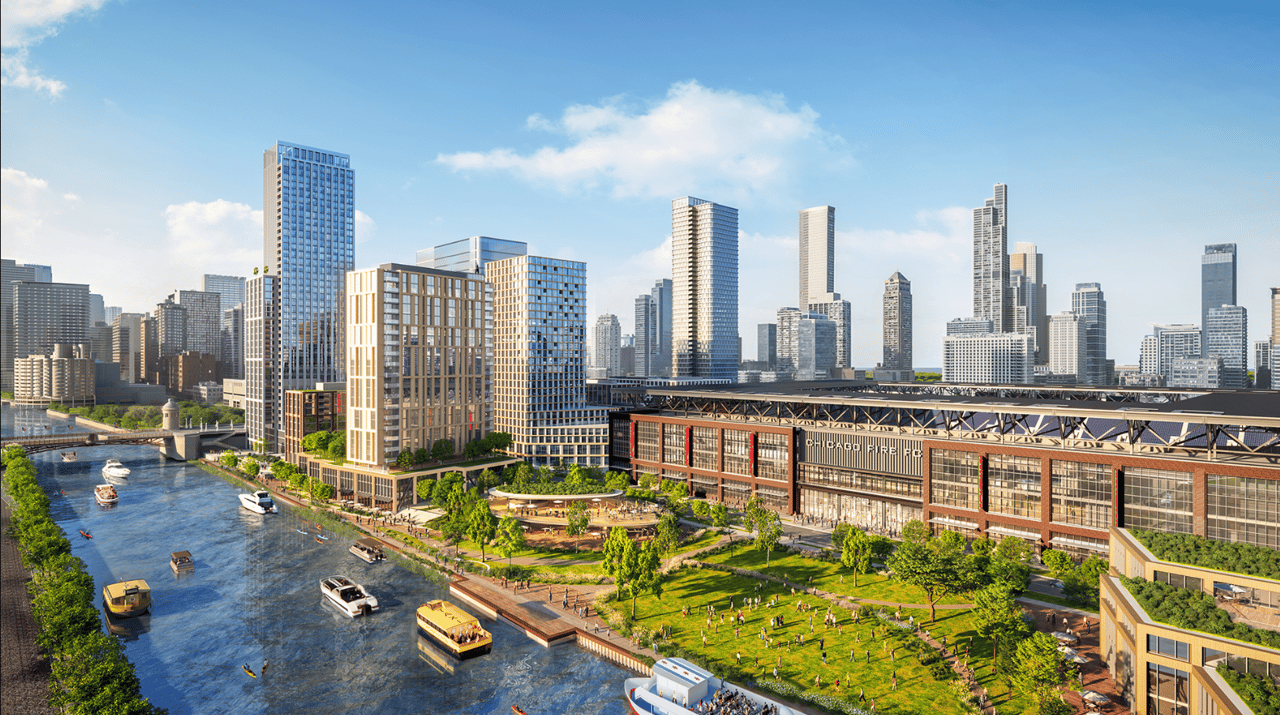
Chicago just committed $425 million in public infrastructure funding to get one of downtown's largest stalled sites moving again, anchored by a new Chicago Fire FC stadium. The City Council gave final approval to the package this week, clearing the last hurdle for construction to move forward. Stadium-anchored development has a mixed track record when it comes to actually lifting nearby property values, so the real question for buyers, sellers, and investors watching the South Loop and West Loop is not just what happened, but whether this particular deal has the ingredients that tend to work.
What Just Happened
The City Council's Finance Committee approved nearly $425 million in tax increment financing, or TIF, for infrastructure at The 78, a 62-acre Related Midwest site along the south branch of the Chicago River, and the full City Council gave final approval to the package this week despite five no votes against a portion of the funding. A TIF district works by capturing the growth in property tax revenue within a designated area and reinvesting it locally, rather than sending it to the city's general fund. The $750 million, 22,000-seat stadium itself, which will be named McDonald's Park, is privately financed by Chicago Fire owner Joe Mansueto, but the public money covers what surrounds it: a $216 million, 1,200-space parking garage, roughly $105 million in road work, and the rest for Metra track upgrades, riverwall repairs, and new park space. Notably, $287 million of that subsidy is being pulled from the Canal/Congress TIF district in the West Loop rather than from The 78's own district, because the site's pivot from an office-and-housing plan to a stadium-anchored one is projected to generate less tax revenue on its own. The stadium broke ground in March and is now cleared to be completed by 2028.
Why This Signals Real Movement, Not Just Talk
The 78 has sat undeveloped for roughly 60 years, and Related Midwest's ownership since 2016 produced little visible progress until now, largely because the site lacked an anchor tenant. Part of what has kept it stalled is physical: there is a 40-foot elevation gap between Roosevelt Road and the site itself, and the parcel is boxed in by Metra tracks and the river with almost no through access. The infrastructure this TIF money funds, including the parking garage that city officials describe as a "podium," is specifically designed to bridge that gap and connect the site to the street grid. That is a meaningful signal: this isn't money for landscaping or amenities, it is money for the physical connectivity problem that has blocked development here for decades.
What This Means for Sellers Nearby
For owners near The 78, the practical question is timing. Years of active road, garage, and Metra construction could mean real disruption in the near term: noise, detours, and construction traffic are common in the years before a project like this matures. Selling before that disruption ramps up is one path. Holding through construction in hopes of capturing value once the stadium opens and the surrounding development materializes is the other, and it carries the execution risk described above. There is no universally right answer here, and it depends heavily on the specific property, how close it sits to the active construction zones, and your own timeline.
Bottom Line
The infrastructure funding behind The 78 has more of the ingredients that tend to correlate with real value growth than a typical stadium deal: it is paired with transit investment, it targets a genuine connectivity problem rather than cosmetic upgrades, and it sits on one of the last large parcels close to downtown Chicago. At the same time, the site's decade-plus of stalled plans, the contentious funding structure, and the still-unbuilt affordable housing mean this is a longer-term, execution-dependent bet rather than a sure thing. This isn't financial advice, and the right move depends on your specific goals, timeline, and risk tolerance.
If you want to talk through how a development like The 78 could affect your buying, selling, or investment decisions nearby, connect with us for guidance on what is happening in the market right now.
FAQs
Is buying property near The 78 a good investment?
- It depends on your timeline and risk tolerance. The deal has features research associates with stronger outcomes, like paired transit investment and downtown proximity, but the site's history of stalled development and ongoing funding controversy mean it carries real execution risk.
Do soccer stadiums reliably increase nearby property values?
- Not automatically, and soccer-specific research is more cautionary than the NFL and MLB data often cited. A study on Seattle condo values after the Sounders joined MLS found nearby property values actually depreciated. Outcomes seem to depend more on whether a stadium is bundled with mixed-use development and transit access than on the sport itself.
Is taxpayer money paying for the Chicago Fire stadium itself?
- No. The $750 million stadium is being privately financed by Chicago Fire owner Joe Mansueto. The $425 million in TIF funds covers surrounding infrastructure, including a parking garage, roads, and Metra upgrades.
Why is West Loop TIF money being used for a South Loop project?
- The revised plan shifts $287 million from the Canal/Congress TIF district in the West Loop into the Roosevelt/Clark TIF district that surrounds The 78, after the project's pivot to a stadium-anchored plan reduced the property tax revenue it was projected to generate on its own.
When is the Chicago Fire stadium expected to open?
- The stadium, which will be named McDonald's Park, broke ground in March 2026 and is on track to open by 2028 now that the City Council has given final approval to its supporting infrastructure funding.
Has any affordable housing been built at The 78 yet?
- Not as of this vote. The city allocated TIF funds for the site in 2019 and has yet to see a unit of affordable housing built, though the terms of that original agreement still require 20% of future residential units to be set aside for low- and moderate-income residents.