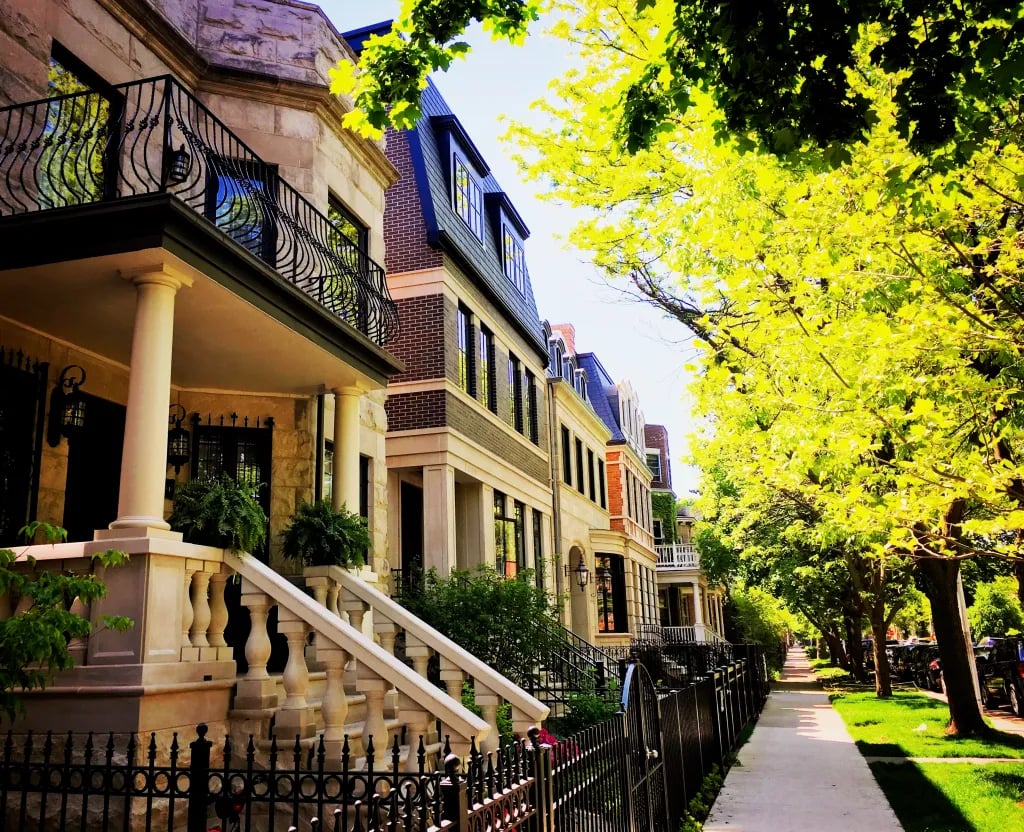
Chicago's Housing Market Is on Fire — But Not Everywhere
Picture this: a two-bedroom condo hits the market in Lakeview on a Thursday. By Saturday morning, there are 20 people lined up for the open house. By Sunday night, the seller has 11 offers — most of them over asking, several waiving inspection contingencies, and at least two with appraisal gap clauses. The home sells for $60,000 above list price. The sellers are stunned. Their agent is not.
This is not an outlier story in Chicago's hottest neighborhoods right now. It is the new normal. While headlines across the country describe a housing market finding its footing — more inventory, more negotiating room, a gradual rebalancing of power between buyers and sellers — Chicago is playing by a different set of rules entirely. The median home price in the Chicago metro area reached $375,000 in March 2026, a year-over-year increase of about 4.2% — more than three times the national average of 1.2%, according to Redfin. In the city's most competitive neighborhoods, that gap feels even wider.
But here's what the data alone doesn't tell you: the sellers who are winning the biggest aren't just lucky. They are strategic. A growing number of Chicago sellers — guided by agents who understand the psychology of scarcity and competition — are actively engineering bidding wars rather than simply hoping for them. They are pricing deliberately, timing carefully, and structuring their sales to concentrate buyer demand into a single, high-pressure moment. The results are redefining what a home is "worth" in neighborhoods like Lincoln Park, Lakeview, Wicker Park, Bucktown, West Town, and River North. This post breaks down exactly how they're doing it — and why it's working.
Setting the Scene: Why Chicago Is Different From the Rest of the Country
To understand why seller strategies that might fall flat in Phoenix or Portland are producing extraordinary results in Chicago, you first have to understand what makes this market structurally unique. Chicago is not experiencing a hot market despite national headwinds — it is experiencing one because of forces that are specific to this city, this inventory landscape, and this moment in time.
The foundation of everything is supply — or rather, the near-total absence of it. Total housing inventory in Chicago declined 13% year-over-year through 2025, with single-family home inventory dropping more than 20%. That kind of supply contraction doesn't just tighten competition — it fundamentally changes the psychology of the transaction. When buyers know that the home they're touring may be one of only a handful available in the neighborhood they want, rational deliberation gives way to urgency. And urgency, as any seasoned Chicago agent will tell you, is the seller's greatest ally.
What makes Chicago's inventory crisis particularly stubborn is that it isn't a temporary dip — it's structural. Listings remain scarce even as home sales fell to their lowest March level in 14 years. That shortage has kept competition intense and pushed values higher across the city and suburbs. Homeowners who locked in low mortgage rates during the pandemic years are deeply reluctant to trade those rates for today's reality of 6%-plus financing. So they stay put, renovate instead of move, and the already-thin supply of available homes gets thinner still. The homes that do come to market become events.
The numbers bear this out in striking fashion. Chicago homes are going pending in just 16 days on average and receiving an average of three offers. That figure — three offers per listing — is the market-wide average, which means that in the city's most competitive neighborhoods, the numbers are considerably higher. Chicago posted price gains between 2.8% and 5.83%, compared with 1.36% nationally, and homes moved faster here than the national average of 55 days on market. Against a national backdrop where buyers are finally gaining some leverage, Chicago's most in-demand neighborhoods are moving in the opposite direction.
Perhaps the most telling sign of just how transformed this market is: the traditional rhythm of the Chicago real estate calendar no longer applies. For decades, conventional wisdom held that spring — March, April, May — was when the serious action happened. Sellers waited for the flowers to bloom before listing. Buyers emerged from winter hibernation ready to buy. That cycle has been disrupted. Competition for homes in Chicago's hottest neighborhoods took off as early as January this year, with pent-up demand, low inventory, and relatively stable mortgage rates fueling a seller's market that simply never cooled down from the year before. The spring selling season didn't start in spring. It never really stopped.
The Neighborhoods Where the Wars Are Being Fought
Not every corner of Chicago is experiencing this phenomenon equally. The city's real estate market has always been a collection of distinct micro-markets, each with its own supply dynamics, buyer demographics, and price trajectories. But in 2026, the divergence between Chicago's hottest neighborhoods and the rest of the city has never been more pronounced. Understanding where the bidding wars are most intense — and why — is essential context for everything that follows.
Lincoln Park and Lakeview sit at the epicenter of Chicago's competition crisis. These are neighborhoods that have long commanded premium prices, but what is happening there now goes beyond the usual desirability premium. The market in these neighborhoods has become uncoupled from normal pricing strategies, with value determined by the depth of buyers' pockets and how badly they want the property. The traditional tools of real estate valuation — comparable sales, price-per-square-foot analysis, days-on-market benchmarks — are losing their utility in real time. Agents describe comparable sales as "within reason, almost irrelevant right now," with homes being pushed well beyond them because of raw demand. When 70% of homes that come to market in a given month sell above their asking price, the asking price itself stops being a meaningful anchor. It becomes a starting point — and sometimes a decoy.
Within Lakeview, the Southport Corridor deserves its own mention as one of the most fiercely contested micro-markets in the entire city. The combination of walkable retail, tree-lined streets, highly rated schools, and a limited stock of single-family homes and larger condos has created a perfect storm of constrained supply meeting outsized demand. Homes here routinely receive multiple offers within days of listing, and the buyers competing for them are increasingly willing to forgo protections — inspection contingencies, financing contingencies, appraisal contingencies — that were considered standard practice just a few years ago. The Southport Corridor is where the gap between list price and final sale price is most likely to make headlines.
Wicker Park and Bucktown, Chicago's creative corridor straddling the Blue Line, are seeing their own version of this intensity. These neighborhoods attract a younger, design-conscious buyer pool — often dual-income households without children, willing to pay a significant premium for architecture, walkability, and neighborhood character. Inventory here has always been constrained by the neighborhood's physical boundaries and the relative scarcity of larger single-family homes, but the past year has pushed competition to new levels. Renovated greystones and two-flats in particular are generating some of the most aggressive bidding activity in the city, as buyers who have lost out on similar properties elsewhere arrive at showings already emotionally primed to win at almost any cost.
West Town, which encompasses sub-neighborhoods like Ukrainian Village and Noble Square, represents perhaps the most interesting competitive dynamic of any area on this list. For years, West Town served as the slightly more affordable alternative for buyers priced out of Wicker Park and Bucktown. That arbitrage opportunity has largely closed. Inventory remains tight enough across the North Side and adjacent neighborhoods to fuel strong competition, with buyers still waiving contingencies and making cash and even sight-unseen offers. West Town's relative value proposition continues to draw buyers, but "relative" is doing a lot of heavy lifting in that sentence — and sellers in the neighborhood are increasingly aware that they hold the leverage.
River North presents a more nuanced picture, and it is worth addressing directly because it illustrates an important truth about Chicago's market: geography alone does not determine competitiveness. River North's condominium-heavy inventory — particularly in the high-rise segment — has historically been slower to recover from the pandemic-era exodus from downtown living. Office return rates, while improving, have not fully restored the demand base that once made luxury downtown condos a sure bet. However, the neighborhood's lower and mid-range condo tiers, as well as its townhome stock, are participating fully in the broader North Side competition story. Buyers who cannot afford or cannot win in Lincoln Park or Lakeview are increasingly looking at River North as an alternative, bringing competitive pressure to a part of the market that, until recently, had been giving buyers room to breathe.
What all of these neighborhoods share — despite their distinct characters, price points, and buyer profiles — is the same fundamental imbalance: far more motivated buyers than available homes. That imbalance is the soil in which the seller strategies we are about to examine have taken root. And as we will see, the sellers and agents who understand how to cultivate that imbalance, rather than simply benefit from it passively, are the ones walking away from the closing table with the most remarkable results.
The Seller Playbook: 5 Strategies Igniting Bidding Wars
If the neighborhoods described above are the kindling, the strategies in this section are the match. What separates the sellers who walk away with $60,000 over asking from those who merely sell at list price is not luck, timing, or even the quality of their home alone — it is deliberate, psychologically informed strategy. The best listing agents in Chicago's competitive neighborhoods have developed a playbook that is equal parts data-driven and deeply human. Here is how it works.
Underprice to Overprice
It sounds counterintuitive to the point of recklessness. Why would a seller deliberately list their home below what it is worth? The answer lies in understanding how buyer behavior changes when a property appears to be a bargain. The strategy — designed to drive traffic and emotional attachment — often results in final sale prices well above what traditional pricing models would predict. Buyers get emotionally invested, and that drives the final price.
When a home in Lakeview or Lincoln Park is priced slightly below market value, something powerful happens: it generates immediate, concentrated interest. Buyers who have been searching for months, losing offer after offer, see the listing and feel a surge of urgency. They show up to the open house already emotionally engaged. They leave wanting to win. And when the offer deadline arrives — more on that shortly — they don't bid at asking. They bid to beat everyone else in the room. The seller's apparent generosity in pricing becomes the mechanism that drives the final number far beyond what a straightforwardly priced listing would have achieved.
This strategy works best in Lincoln Park, Lakeview, and the Southport Corridor, where the buyer pool is deep enough and competitive enough that underpricing reliably generates the volume of offers needed to push prices skyward. In neighborhoods with thinner buyer pools, the risk of underpricing without generating sufficient competing interest is real — which is why hyper-local market knowledge is essential before deploying this tactic.
Throw Out the Comps
In a normal market, comparable sales — "comps" — are the bedrock of pricing strategy. An agent pulls recent sales of similar homes in the same neighborhood, adjusts for differences in size, condition, and features, and arrives at a defensible list price. It is a rational, data-driven process that serves buyers and sellers alike. In Chicago's hottest neighborhoods right now, that process is increasingly beside the point.
In many cases, brokers say comparing similar properties for pricing is almost unnecessary. About 70% of homes listed this year and sold in the last month in the Lincoln Park, Lakeview, Wicker Park, and Bucktown region sold over their asking price. When the majority of transactions are closing above list, the comps themselves become outdated almost as soon as they are recorded. Yesterday's sale price is today's floor, not today's ceiling. Agents working in these neighborhoods are increasingly pricing based on forward-looking demand signals — how many buyers are actively searching, how quickly similar listings have moved, how many offers recent comparable sales received — rather than backward-looking transaction data.
For sellers in West Town and Bucktown in particular, this represents a meaningful opportunity. These neighborhoods have historically been priced at a discount to their more established neighbors to the east. But as buyer demand migrates westward from Lincoln Park and Lakeview, the comps in West Town and Bucktown are being reset in real time. Sellers who anchor their expectations to last year's comparable sales risk leaving significant money on the table. The market has moved — and in many cases, it has moved faster than the data has caught up.
Time the Listing Strategically
Timing in real estate has always mattered. What has changed in Chicago's current market is which timing decisions matter most — and the answers are not what most sellers expect. The conventional wisdom that late spring is the optimal time to list, when the weather is warm and the city is at its most photogenic, is being quietly retired by the agents producing the best results for their seller clients.
Early-season listings often benefit from a powerful dynamic: they face less competition from other sellers while demand is already building. When buyer activity increases while inventory remains relatively tight, the homes that do hit the market tend to attract significant attention. A seller who lists in late January or February in Wicker Park or River North is not competing against the wave of spring listings that will arrive in April and May. They are meeting a buyer pool that has been pent up all winter — frustrated, motivated, and ready to act decisively.
The other timing consideration that sophisticated sellers are increasingly attentive to is the day of the week their listing goes live. Homes that hit the market on a Wednesday or Thursday, with a weekend open house already scheduled, create an immediate sense of occasion. Buyers have two or three days to see the listing, discuss it with their partners, get pre-approved if they haven't already, and arrive at the open house emotionally prepared to compete. A Monday listing, by contrast, risks losing momentum before the weekend audience ever engages.
Create Urgency With Offer Deadlines
Of all the strategies in the modern Chicago seller's playbook, the offer deadline may be the single most powerful — and the most psychologically sophisticated. Rather than accepting offers on a rolling basis as they arrive, sellers working with the best agents in Lincoln Park, Lakeview, and the Southport Corridor are increasingly setting a specific date and time by which all offers must be submitted. The effect on buyer behavior is dramatic.
When buyers know that a decision must be made by Sunday at 5pm, several things happen simultaneously. First, they cannot afford to sleep on it, request a second showing a week later, or wait to see if something better comes along. The deadline forces commitment. Second, they know — or strongly suspect — that other buyers are facing the same deadline, which transforms the transaction from a negotiation into a competition. Sellers are concentrating buyer competition into single high-pressure moments rather than allowing it to dissipate across days of back-and-forth negotiation. Third, and most importantly, the deadline creates a ceiling effect in reverse — instead of a price ceiling, it creates a price floor, as buyers who genuinely want the home ask themselves not "what is this worth?" but "what do I need to offer to win?"
This strategy is particularly effective in the Southport Corridor and Bucktown, where the scarcity of truly move-in-ready, well-designed homes means that losing out on one property can set a buyer's search back by months. That asymmetry — the seller can always find another buyer, but the buyer may not find another home like this one for a very long time — is the psychological engine that makes offer deadlines so potent.
Use Rent-Back Agreements as a Strategic Tool
One of the most underappreciated challenges facing sellers in a tight market is this: once you sell, where do you go? In a city where the same inventory shortage that makes it a great time to sell also makes it a deeply competitive time to buy, sellers face the uncomfortable reality of needing to navigate both sides of the market simultaneously. The rent-back agreement is how the savviest sellers are solving that problem — and turning it into a negotiating advantage in the process.
Sellers are leveraging the market by requesting rent-back agreements, allowing them to remain in their homes temporarily after closing while they search for their next property. In practice, this means the buyer takes legal ownership of the home at closing but agrees to let the seller continue living there — typically for 30 to 60 days — in exchange for a daily rent payment. For the seller, this eliminates the terrifying prospect of selling into a competitive market without a clear landing spot. For the buyer, agreeing to a rent-back is often the difference between winning and losing in a multiple-offer situation, making it a concession many are willing to make.
In neighborhoods like Lincoln Park and West Town, where sellers are often move-up buyers looking to purchase their next home in the same competitive environment they are selling in, rent-back agreements have become nearly standard practice. They allow sellers to close, pocket their equity, and then re-enter the buying market as cash-rich, non-contingent purchasers — a position of enormous strength. What began as a practical solution to a logistical problem has evolved into a deliberate strategic tool, one that makes the seller's home more attractive to buyers while simultaneously strengthening the seller's own position in their next transaction.
Taken together, these five strategies represent something more than a collection of clever tactics. They reflect a fundamental shift in how the best sellers and agents in Chicago are thinking about the transaction — not as a passive process of listing and waiting, but as an active, engineered event designed to maximize competition, concentrate demand, and extract the highest possible value from a market that, if approached correctly, is arguably the most favorable selling environment this city has seen in a generation.
The Buyer Psychology Behind Why It Works
Strategy without psychology is just mechanics. What makes the seller playbook described in the previous section so effective in Chicago's hottest neighborhoods is not simply that it follows a logical sequence of steps — it is that every step is calibrated to exploit deeply human patterns of behavior under conditions of scarcity, competition, and time pressure. To understand why these strategies produce such extraordinary results, you have to get inside the mind of the buyer standing at an open house in Lakeview on a Saturday morning, knowing that eleven other people are walking through the same rooms.
Scarcity Changes Everything
The starting point for understanding buyer psychology in this market is the concept of scarcity — not as an abstract economic condition, but as a visceral, felt experience. First-time buyers and growing households face fewer choices and more bidding wars, with buyer strategies increasingly requiring faster decisions, flexible budgets, and acceptance of imperfect homes. When a buyer has been searching for six months in Wicker Park or Bucktown, touring home after home, losing offer after offer, something fundamental shifts in their decision-making framework. They stop evaluating each property on its own merits and start evaluating it relative to the fear of losing again. That fear — not the home's square footage or its kitchen finishes — becomes the primary driver of how much they are willing to pay.
This is the psychological condition that Chicago's most competitive neighborhoods are reliably producing in 2026, and it is the condition that makes every strategy in the seller's playbook more powerful than it would be in a balanced market. Scarcity doesn't just increase demand — it changes the nature of demand, transforming rational calculation into emotional urgency.
The FOMO Premium
Real estate agents in Lincoln Park, Lakeview, and the Southport Corridor have long understood something that behavioral economists have documented extensively: people are more motivated by the prospect of losing something than by the prospect of gaining something of equivalent value. Loss aversion, as it is formally known, is one of the most robust findings in all of behavioral science — and in a multiple-offer situation with a Sunday deadline, it operates at full intensity.
When a buyer submits an offer knowing that other buyers are doing the same, they are not just deciding what the home is worth to them. They are deciding how much they are willing to pay to avoid the specific, painful experience of losing — of getting the phone call on Monday morning that someone else's offer was accepted, of having to tell their family they didn't get the house, of starting the search all over again in a market where the next comparable property may not appear for months. That calculation produces what might be called the FOMO premium — the additional dollars a buyer is willing to commit not because the home is worth more, but because losing it feels intolerable. In Bucktown and West Town, where truly move-in-ready homes are genuinely rare, that premium can be substantial.
Emotional Investment as Price Driver
The deliberate underpricing strategy described in the previous section works not just because it generates more showings, but because of what happens to buyers emotionally during those showings. A home that appears to be attractively priced draws buyers who might otherwise not have engaged — and once they are inside, walking through the rooms, imagining their furniture, their mornings, their lives in that space, the price they arrived willing to pay becomes almost irrelevant. Buyers get emotionally invested, and that drives the final price.
This emotional investment is particularly powerful in neighborhoods like River North and West Town, where the homes that generate the strongest buyer responses tend to be ones with distinctive architectural character — renovated greystones, converted lofts, vintage two-flats with original details intact. These are not interchangeable units. They are homes with personality, and buyers who fall for them fall hard. By the time the offer deadline arrives, a significant portion of the competing buyer pool has mentally moved in. They are no longer bidding on a property — they are fighting for their future home. The seller, having engineered that emotional state through strategic pricing, open house presentation, and deadline pressure, is the direct beneficiary.
The Contingency Calculation
One of the most striking behavioral shifts in Chicago's competitive neighborhoods is the widespread willingness of buyers to waive contingencies that were, until recently, considered non-negotiable consumer protections. Inspection contingencies, financing contingencies, appraisal gap contingencies — all of these exist to protect the buyer from specific risks: hidden defects, loan approval failures, and the gap between what a lender will finance and what the market demands. Buyers are still waiving contingencies and making cash and even sight-unseen offers across Lincoln Park, Lakeview, Bucktown, and adjacent neighborhoods, accepting levels of risk that would have seemed extraordinary just a few years ago.
What drives this behavior is not recklessness — most of these buyers are sophisticated, financially capable adults making deliberate choices. It is the competitive calculus of a market where every protection you demand is a potential reason for the seller to choose someone else. In a ten-offer situation on a Southport Corridor townhome, a buyer who insists on an inspection contingency is signaling hesitation in a room full of people signaling absolute commitment. The psychology of the group — the knowledge that others are going further — creates a ratcheting effect, where each buyer's willingness to take on risk is shaped partly by their assumption of how much risk their competitors are absorbing.
When Bidding Wars Hit the Rental Market
The competitive psychology of Chicago's for-sale market has spilled, remarkably, into the rental market as well — a development that illustrates just how thoroughly the underlying supply imbalance has reshaped housing dynamics across the city. Chicago renters are facing bidding wars — competing for apartments the way homebuyers do, paying roughly $100 more per month than a year ago, with showings in neighborhoods like Avondale and Logan Square regularly drawing lines of 20 or more potential renters. Some applications are even asking how much above the listed rent applicants are willing to pay.
This matters for the for-sale market in a specific and direct way. Renters who are experiencing bidding wars for apartments — who are being asked to offer above listed rent just to be considered — are simultaneously building the psychological muscle memory of competitive housing dynamics and developing an increasingly urgent motivation to exit the rental market entirely. Every renter who loses a bidding war for an apartment in Logan Square is a potential future buyer in West Town or Wicker Park, arriving at their first open house already conditioned to the reality that hesitation costs you the home. The rental market's competitiveness is, in effect, producing the next generation of aggressive homebuyers.
The Compounding Effect
What makes buyer psychology in this market so potent — and so useful to sellers who understand it — is that none of these forces operate in isolation. Scarcity amplifies FOMO. FOMO amplifies emotional investment. Emotional investment reduces the perceived cost of waiving contingencies. The offer deadline concentrates all of these pressures into a single moment of decision. And the rental market's own competitiveness ensures a steady supply of buyers who arrive at the for-sale market already primed for urgency.
The sellers and agents in Lincoln Park, Lakeview, the Southport Corridor, Wicker Park, Bucktown, West Town, and River North who are engineering the most successful sales in 2026 are not manipulating buyers — they are creating conditions in which buyers' own psychology does the work. The home becomes the prize, the deadline becomes the starting gun, and the final sale price becomes the natural outcome of a process designed, from the very first showing, to make winning feel essential and losing feel unthinkable.
What the Data Says for the Rest of 2026
Strategy and psychology are powerful, but they operate within a market context that is ultimately shaped by data — inventory levels, price trajectories, mortgage rate movements, and sales volume forecasts. For sellers weighing whether to act now or wait, and for buyers trying to understand what they are walking into, the numbers tell a story that is at once encouraging, sobering, and in Chicago's case, distinctly different from the national narrative.
The Price Trajectory
The most important data point for anyone participating in Chicago's housing market right now is the direction and pace of price growth — and by both measures, Chicago continues to outperform virtually every comparable major metro in the country. Inside city limits, home prices rose about 5.4% year-over-year in March, hitting a median of $411,000. Chicago ranks 15th out of 48 major metro areas for year-over-year price growth tracked in Redfin data, with metro-wide price growth more than three times the national average. That kind of sustained outperformance, in a national environment where price growth has largely moderated, speaks to the structural nature of Chicago's supply imbalance rather than a temporary cyclical surge.
Looking further out, the forecasts remain bullish for Chicago even as they diverge on the precise magnitude of future gains. Reventure projects Chicago metro price gains of 6.4% over the next twelve months, while Zillow is more cautious at 1.2%. The Institute for Housing Studies at DePaul University also expects further price increases through 2026. The spread between the most optimistic and most conservative forecasts is wide, reflecting genuine uncertainty about how mortgage rates, inventory releases, and broader economic conditions will interact over the coming months. What the forecasts agree on, however, is the direction: prices in Chicago are not expected to fall. The floor feels solid.
The Inventory Outlook
If price trajectory is the headline, inventory is the underlying story — and here the data offers little comfort to buyers hoping for relief. Chicago posted price gains significantly above the national average even as home sales fell to their lowest March level in 14 years, with the shortage keeping competition intense and pushing values higher across the city and suburbs. That combination — falling sales volume and rising prices — is the signature of a supply-constrained market rather than a demand-driven one. It means that even as some buyers step back due to affordability pressures, the homes that do come to market are not getting cheaper. There simply are not enough of them.
The structural forces keeping inventory low are not expected to resolve quickly. Homeowners who locked in mortgage rates between 2020 and 2022 face a powerful financial disincentive to sell and re-enter the market as buyers at today's rates — a phenomenon economists call the "lock-in effect." According to Freddie Mac, the U.S. is still short approximately 3.7 million homes, meaning supply has not kept up with long-term demand. Inventory is not just low — it is being held back by financial decisions, not lack of desire to sell. In Chicago's most desirable neighborhoods, where the gap between a seller's current mortgage rate and the prevailing market rate is largest, this lock-in effect is most acute — and most likely to persist through the remainder of 2026 and beyond.
The Mortgage Rate Reality
Mortgage rates remain one of the most closely watched variables in the 2026 housing market, and their trajectory has significant implications for both the intensity of bidding wars and the sustainability of Chicago's price growth. Industry forecasts indicate that mortgage rates could trend lower in 2026, settling around the low-to-mid 6% range — making homebuying more accessible than the past few years. That modest improvement in financing conditions, if it materializes, is unlikely to dramatically alter the competitive dynamics in Lincoln Park or Lakeview — the buyer pools in those neighborhoods are sufficiently motivated and financially capable that a half-point rate movement changes monthly payments at the margin without fundamentally changing behavior. But in neighborhoods like West Town and River North, where buyers are more rate-sensitive, even incremental improvements in financing conditions could unlock meaningful additional demand.
The risk, of course, is that lower mortgage rates bring both buyers and sellers off the sidelines simultaneously. More buyers means more competition — good for sellers who are already in the market. But more sellers means more inventory — which could begin, over time, to moderate the scarcity conditions that have made Chicago's hottest neighborhoods so extraordinarily favorable for sellers. The balance between these two forces will be one of the defining dynamics of the Chicago housing market through the remainder of 2026.
Seller Confidence and the Strategic Imperative
At the national level, seller sentiment heading into the back half of 2026 is notably strong — but it is increasingly paired with a recognition that confidence alone is not a strategy. According to Realtor.com, 83% of potential sellers expect to receive their asking price or more, including 37% who believe they will get above asking. However, 39% of potential sellers anticipate making concessions to buyers in 2026, up from 30% last year. That rising concession rate is not a sign of market weakness — it is a sign of market maturation. Sellers are learning that the gap between a good outcome and a great outcome is determined not by market conditions alone, but by how intelligently those conditions are exploited.
"The sellers who are most likely to succeed this spring are the ones who are listing a well-priced, move-in-ready home and doing so before the summer surge in competition," according to senior economic research at Realtor.com. "In markets where inventory is tighter — particularly across the Northeast and Midwest — motivated sellers are still in a strong position." Chicago sits squarely in that category. But the operative phrase is "well-priced" — not high-priced, not conservatively priced, but strategically priced in a way that reflects a sophisticated understanding of local demand. In Lincoln Park and the Southport Corridor, well-priced increasingly means priced to ignite, not priced to anchor.
The Divergence Within Chicago
Perhaps the most important data-driven insight for anyone navigating this market is that Chicago's aggregate numbers, impressive as they are, mask significant variation at the neighborhood level. Move-in ready, well-designed homes are commanding strong competition, while homes needing updates or priced too high are sitting longer and creating negotiation opportunities for buyers. This divergence — between the homes that generate bidding wars and the homes that linger — is not random. It maps almost perfectly onto the neighborhood dynamics described earlier in this post. In Wicker Park, Bucktown, and West Town, a renovated home with strong design and modern systems will sell in days with multiple offers. An unrenovated home in the same neighborhood, priced as though the market will do the work, may sit for weeks while its owner watches comparable properties sell for more.
The Illinois REALTORS® 2026 Annual Forecast captures the broader optimism underlying these dynamics: the Chicago metropolitan area is projected to see a 5.1% increase in closed home sales compared with 2025, signaling a stronger and more active market, with median home prices expected to grow by nearly 5% year-over-year. Those are healthy, sustainable numbers — not the euphoric double-digit swings of the pandemic years, but strong enough to reward sellers who act thoughtfully and punish those who either wait too long or approach the market without a strategy.
The data, in other words, tells the same story that the agents in Lincoln Park and Lakeview have been telling their clients all year: the window is open. The conditions are favorable. But favorable conditions and maximum results are not the same thing — and the distance between them is measured in strategy.
What This Means If You're Thinking of Selling in Chicago
All of the data, neighborhood analysis, and strategic insight in the preceding sections converge on a single practical question for the homeowner sitting on the fence in 2026: is now the right time to sell, and if so, how do I make the most of it? The honest answer is that the conditions described in this post — the inventory shortage, the buyer psychology, the price trajectory, the competitive neighborhood dynamics — represent one of the most favorable selling environments Chicago has seen in a generation. But favorable conditions and maximum results are not the same thing. The difference is preparation, positioning, and the quality of the decisions you make before your home ever hits the market.
The Window Is Open — But Windows Close
The single most important thing to understand about Chicago's current market is that its extraordinary competitiveness is not a permanent feature of the landscape. It is the product of a specific confluence of forces — historically low inventory, pent-up buyer demand, relatively stable mortgage rates, and a buyer psychology shaped by years of frustration and scarcity — that will not persist indefinitely. When buyer activity increases while inventory remains relatively tight, the homes that do hit the market tend to attract significant attention. But as more homes come to market, sellers who list earlier often find themselves in a stronger position than those who wait for the traditional peak.
The sellers who will look back on 2026 as the year they made an exceptional financial decision are not the ones who waited for the perfect moment. They are the ones who recognized that the perfect moment was already here and acted on it with intention. In Lincoln Park, Lakeview, Wicker Park, Bucktown, West Town, and the Southport Corridor, that recognition is worth real money — potentially tens of thousands of dollars in additional proceeds compared to a sale attempted in a more balanced market environment.
Preparation Is the New Negotiation
In a market where buyers are waiving inspection contingencies and making sight-unseen offers, it might be tempting to conclude that preparation — staging, repairs, professional photography, pre-listing inspections — matters less than it used to. The data suggests precisely the opposite. Move-in ready, well-designed homes are commanding strong competition, while homes needing updates or priced too high are sitting longer and creating negotiation opportunities for buyers. The divergence between these two categories of homes — the ones that ignite bidding wars and the ones that linger — is driven in large part by presentation and condition.
This is particularly true in neighborhoods like River North and West Town, where the buyer pool includes a significant proportion of design-conscious, professionally successful buyers who have strong aesthetic preferences and limited tolerance for renovation projects. A home that shows beautifully — fresh paint, decluttered spaces, well-lit rooms, landscaping that makes a strong first impression — is not just more attractive than an unprepared home. It is categorically different in the eyes of a buyer who has been searching for months and has developed an almost instantaneous sense of whether a home feels right. That feeling, triggered in the first thirty seconds of a showing, is what turns a prospective buyer into a competing bidder.
Pricing Strategy Is Everything
If preparation gets buyers through the door, pricing strategy determines what happens once they are inside. And in Chicago's most competitive neighborhoods, pricing strategy in 2026 requires a level of nuance and local knowledge that goes well beyond pulling comparable sales and splitting the difference. The fundamental question a seller must answer — with the guidance of an agent who genuinely understands their specific micro-market — is not "what is my home worth?" but "what price will generate the maximum competitive response from the available buyer pool?"
Those are meaningfully different questions, and they often lead to meaningfully different answers. Competition is especially strong in neighborhoods like Lincoln Park and Lakeview, where homes often sell for tens of thousands over asking prices and bidding wars are routine. In that environment, a seller who lists at what they believe to be full market value may find themselves receiving one or two offers and closing at or near asking. A seller who lists strategically below that number may find themselves fielding eight offers and closing $50,000 above it. The math, counterintuitive as it feels, consistently favors the latter approach in the right neighborhoods.
Choose Your Agent as Carefully as You Price Your Home
The strategies described throughout this post are not self-executing. They require an agent who has deployed them before, who understands the specific buyer psychology of your neighborhood, who has the professional network to generate genuine pre-market buzz, and who has the confidence to recommend a pricing approach that may feel uncomfortable until the offers start arriving. In a market where the gap between a good agent and a great one can be measured in five or six figures of additional proceeds, the selection of your listing agent is arguably the highest-leverage decision you will make in the entire selling process.
This is especially true in micro-markets like the Southport Corridor and Bucktown, where the buyer pools are well-defined, the agents who work them most actively have deep relationships with buyer representatives, and the difference between a listing that generates buzz before it hits Zillow and one that launches cold into the market can be the difference between three offers and twelve. When a property is highly desirable, it can have 12 to 24 showings in 48 hours and end up with multiple offers. Homes that are properly priced and well prepared are averaging seven to fifteen days on the market. That kind of performance does not happen by accident — it is the result of an agent who has done the work before the sign goes in the ground.
Timing Your Next Move
For many sellers in Chicago's competitive neighborhoods, the decision to sell is inseparable from the question of what comes next. If you are selling a home in Lincoln Park in order to buy in Lakeview, or selling in Wicker Park to move to the North Shore, you are not just navigating one competitive market — you are navigating two simultaneously. The rent-back agreement strategy discussed earlier in this post is one solution to this challenge. Another is the careful sequencing of your sale and purchase timelines, ideally with the guidance of an agent who can coordinate both transactions and help you deploy the equity from your sale as a competitive advantage in your next purchase.
Housing inventory in the Chicagoland area sits around two months' supply — well below the healthy market average of six months — meaning prices are likely to remain elevated until more homes are available. For sellers who are also buyers, that reality cuts both ways. It means your sale will likely go well. It also means your purchase will likely be competitive. Planning for both — financially, emotionally, and logistically — is the difference between a smooth transition and a stressful one.
The Bottom Line for Chicago Sellers
The Chicago housing market in 2026 is not offering sellers a guarantee. It is offering them an opportunity — one that is larger, more lucrative, and more time-sensitive in certain neighborhoods than in others, but an opportunity nonetheless. The sellers who will make the most of it are those who resist the temptation to be passive, who invest in preparation before listing, who trust a data-informed pricing strategy even when it feels counterintuitive, and who choose representation that understands not just the market in the abstract but the specific block, the specific buyer pool, and the specific psychology of the neighborhood where their home sits.
In Lincoln Park, Lakeview, the Southport Corridor, Wicker Park, Bucktown, West Town, and River North, the conditions for an exceptional sale exist right now. The question is not whether the market will work for you. It is whether you will work the market.
The New Rules of Selling in Chicago
There is a version of the Chicago real estate story that tells itself simply: low inventory, high demand, prices go up. That version is true as far as it goes. But it misses the more interesting and more instructive story underneath — the one about sellers who stopped waiting for the market to reward them and started engineering the conditions for their own extraordinary outcomes.
The bidding wars lighting up Lincoln Park, Lakeview, the Southport Corridor, Wicker Park, Bucktown, West Town, and River North in 2026 are not purely spontaneous events. They are, in the best cases, carefully constructed ones. They are the product of sellers and agents who understand that scarcity is not just a market condition — it is a psychological trigger. That a deadline is not just a scheduling tool — it is a pressure mechanism. That a list price is not just a number — it is the opening move in a strategic sequence designed to end with multiple buyers competing fiercely for a single home.
The market in Chicago's most competitive neighborhoods has become uncoupled from normal pricing strategies, with value determined by the depth of buyers' pockets and how badly they want the property. That uncoupling is not a flaw in the system. For sellers who understand it, it is the opportunity. Because when comparable sales stop being the ceiling and desire starts being the price driver, the seller who has done everything right — prepared the home meticulously, priced it strategically, timed the listing deliberately, structured the offer process to concentrate competition — is no longer selling a home at market value. They are creating a new market value, one transaction at a time.
The data supports continued optimism for Chicago sellers through the remainder of 2026 and into 2027. The Chicago metropolitan area is projected to see a 5.1% increase in closed home sales, with median home prices expected to grow by nearly 5% year-over-year. Inventory is not expected to recover meaningfully in the near term. The lock-in effect that keeps potential sellers on the sidelines will persist as long as the gap between pandemic-era mortgage rates and today's rates remains wide. And the buyer pool — swelled by frustrated renters who have watched apartment bidding wars with growing alarm, by move-up buyers who have been building equity in a rapidly appreciating market, and by relocating professionals drawn to Chicago's relative affordability compared to coastal cities — is not going anywhere.
But markets do not stay exceptional forever. The window that Chicago's most competitive neighborhoods are offering their sellers right now — the convergence of thin inventory, deep buyer demand, and a psychological environment primed for competition — will eventually give way to something more balanced. It always does. The question that every homeowner in Lincoln Park, Lakeview, Wicker Park, Bucktown, West Town, and River North should be sitting with is not whether conditions will eventually normalize. They will. The question is whether, when they look back from that more balanced future, they will feel they made the most of the moment they were given.
The new rules of selling in Chicago in 2026 are, at their core, not really about real estate at all. They are about understanding human behavior under conditions of scarcity, about the courage to price counterintuitively, about the discipline to prepare thoroughly when the temptation is to list quickly, and about the wisdom to recognize that a genuinely exceptional market does not excuse you from the need for strategy — it rewards you for having one. The sellers who internalize those rules are the ones walking away from the closing table with numbers that make their neighbors' jaws drop.
Picture that same two-bedroom condo in Lakeview. The open house on Saturday morning. The twenty people in line. The eleven offers by Sunday night. The final sale price, $60,000 above asking. Now picture the seller — not stunned, as we imagined them at the beginning of this post, but quietly satisfied. Because they knew, from the moment they decided to sell, exactly how this was going to go. They had read the market. They had trusted the strategy. They had done the work.
That is the real story of Chicago real estate in 2026. And for sellers who are paying attention, it is still being written.
Stop guessing what your home is worth. In this market, the right strategy matters more than the right number. Let's build yours.
Sources: The Real Deal Chicago, Redfin, Axios Chicago, United States Real Estate Investor, Chicago Agent Magazine, Illinois REALTORS®, Realtor.com, Freddie Mac, Institute for Housing Studies at DePaul University