Three bridges closed within a single month, and the city never coordinated any of it.
Last year, Chicago closed the Cortland Street, Chicago Avenue, and Lake Street bridges within about two weeks of each other, on top of the State Street bridge, which was already down: four Chicago River crossings gone at once, all funneling traffic onto the same handful of remaining streets. Ald. Brian Hopkins didn't mince words, calling the pileup a "clusterf—" and pointing out that ambulances couldn't get where they needed to go.
There was no public hearing, no published traffic mitigation plan, and no coordinated timeline across projects that all dumped cars onto the same detour routes.
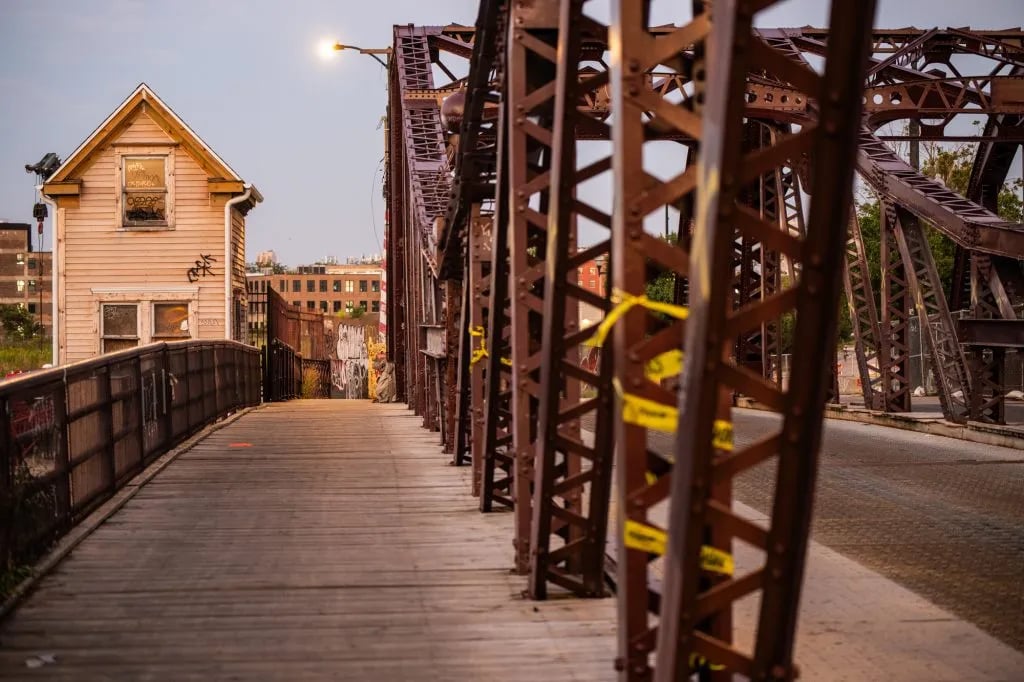
Cortland is the bridge that shows what happens when "temporary" construction meets a city that didn't fully know what it was dealing with. The bridge was closed in September 2025 with an 18-to-24-month completion estimate, which was annoying but bearable since there was at least an end date on the calendar. Then CDOT found severe steel corrosion that nobody had flagged going in, and that estimate evaporated. A year later, there's still no new completion date, and aldermen are now talking about stripping the bridge's 124-year-old landmark status in order to tear it down and start over, which would be much faster than trying to repair it. Either way, the city closed a major crossing without a clear handle on its condition, and neighbors have dealt with the consequences ever since.
Compare that to the Chicago Avenue Bridge, which is at least holding closer to its original timeline, with CDOT still projecting a December 2026 finish, except that even this "success story" is already inching later, with one alderman pointing to January 2027 as the more realistic target. The bridge that's going to slip past its published date isn't bad luck twice; it's a sign the estimates were never built with much cushion for what the city didn't yet know.
The city's response to the fall 2025 chaos was to pass an ordinance requiring CDOT to hold a public hearing and present a traffic mitigation plan before any bridge closure longer than 30 days. That ordinance only exists because none of that was required before. Legislating a process into existence after the damage is done is about as clean an admission as you'll get that the process didn't exist when it actually mattered.
None of this is really about whether these bridges needed repair: they did, and 1 in 6 of Chicago's bridges are rated "poor," more than double the national average, with funding that has never kept pace with the need. That's a real problem, but it's a separate one, because knowing you already have 100 bridges in bad shape is exactly the argument for scheduling closures with some foresight, not for discovering, bridge by bridge, that the city didn't know what it was getting into.
With that many bridges in poor condition and still no comprehensive plan for sequencing the work, "closed indefinitely " will keep happening until the city treats planning as part of the job, not something it does only after the backups make the news.